|
|
Last Modified on Jan 26, 2026
Texas weapons laws are some of the most discussed, yet misunderstood, laws in the country. While many people assume they know what is legal based on headlines or word of mouth, the reality is that Texas weapon regulations are complicated. Small distinctions can make the difference between a legal behavior and a firearm violation. For example, the way a weapon is carried or how it is stored. Understanding them is essential to avoiding any unnecessary issues.
How Texas Categorizes Weapon-Related Offenses
Texas tracks weapon offenses using detailed classifications that reflect how often firearms and other weapons intersect with criminal charges. Rather than treating all incidents the exact same, offense reporting is grouped by how a weapon factors into the alleged conduct.
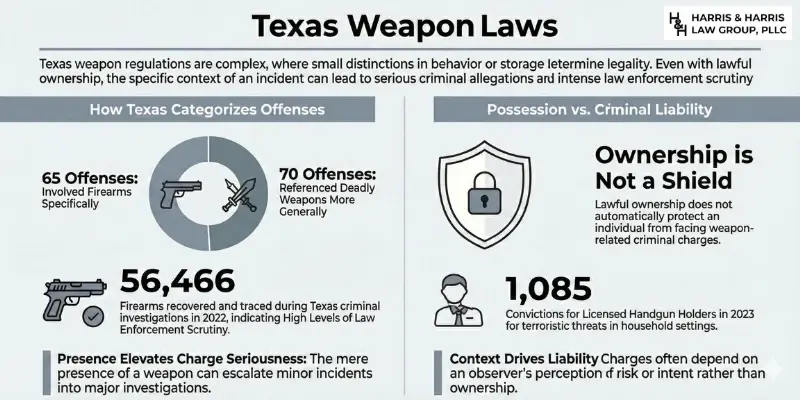
For example, Texas DPS categorizes offenses into three different broad groups. In 2023, this broke down to:
- 65 offenses that involved only a firearm or handgun
- 70 offenses that referenced a deadly weapon more generally
- 25 offenses that involved a firearm, handgun, or other type of weapon
These three distinctions matter, as the category of an offense into which a case falls can have an impact on how a case is investigated and charged. Even when a weapon isn’t used, its alleged presence can elevate the seriousness of the accusation. Regardless of how serious or minor your case may seem, it’s always wise to secure the support of a defense lawyer to be as prepared as possible for what might evolve in the process.
Firearms and Law Enforcement Scrutiny in Texas
Firearms play a significant role in how weapon-related cases are investigated across the state. In 2022, there were 56,466 firearms recovered and traced in Texas. This gives some insight into how frequently weapons become part of criminal investigations.
This level of enforcement activity means that weapon allegations often involve:
- Ballistic testing or tracing
- Ownership and possession questions
- Prior contact with law enforcement databases
- Chain-of-custody issues
In many different situations, the sheer presence of a firearm can quickly turn an incident into a broader weapon crime investigation. This is true even if the underlying situation began as something far less severe.
When Legal Possession Still Leads to Charges
One of the more misunderstood aspects of Texas weapon laws is that lawful ownership does not automatically shield you from criminal charges. The state has a history of licensed gun holders facing serious allegations, depending on what they were accused of doing.
For example, Texas data shows that in 2023, there were 1,085 convictions involving terroristic threats within family or household settings by licensed handgun holders. This statistic shows how context, not just possession, can drive criminal liability. Any situation where emotions are heightened, and verbal statements can be perceived as a threat is often closely scrutinized by the alleged victim and prosecution.
These cases frequently turn on questions such as:
- How statements were interpreted by others
- Whether the conduct was seen as threatening
- The surrounding environment and prior history
- Whether the presence of a weapon escalated the situation
In these situations, charges are less about ownership and more about the individual’s perception of risk or intent. For example, what may have felt like a simple verbal argument that happens on an ordinary day can be interpreted very differently by someone on the receiving end. Context matters, and your defense lawyer will help to make sure your side of the story is not only heard but deeply considered as part of the case’s evaluation.
Hire a Weapons Charge Lawyer
At Harris & Harris Law Group, PLLC, we focus on people over volume. That matters when trusting someone to manage your weapons charge. Built on the core values and work ethic of two hard-working twins, we have seen just how much these allegations can disrupt life for our past clients. With more than twenty years of experience on both sides of the courtroom, our experience is why so many before you have chosen to hire a weapons charge lawyer from our firm.
FAQs
What Weapons Can I Legally Carry in Texas?
Texas generally allows individuals to carry certain weapons, but legality will often depend on the type of weapon and how it was carried. For instance, items that are commonly lawful in one context might become an issue in another. The specific location or behavior during an interaction is often what is questioned when determining legality. Intent, behavior, and how the weapon was displayed matter just as much as being able to say you legally own the weapon.
How Are Texas Gun Laws Different From Other States?
Texas is often viewed as more permissive than many other states in the public’s eye, but that doesn’t mean there aren’t rules to follow. While there are other states you could cite that have broader restrictions, Texas places more focus on the individual situation at hand. It’s why some people find themselves in a legal case when traveling from another state or relying on a general sense of the rules to guide their behavior rather than consulting with an attorney.
Can I Open Carry in Texas?
Open carry is generally allowed throughout Texas, but there are limitations to be aware of. When you are open carrying in Texas, how the firearm is carried and how others perceive it are important considerations. Openly carrying a weapon does not protect you from scrutiny if someone feels your conduct appears inappropriate. Because of this, private property owners must also set their own rules to keep those around them feeling safe.
Can a Weapon Charge Apply Even If the Weapon Was Never Used?
You could still face a weapon charge even if you never directly used it during the interaction in question. In fact, the mere presence of a weapon could change how an incident is viewed by others. The perception of fear in charges involving weapons can create a difficult and complex legal case that may seem unwarranted. If you are facing a weapons charge in Texas, speak with a lawyer who can review the unique details of your case.
Contact A Texas Weapons Charge Lawyer
Weapon laws in Texas are complicated, and misunderstandings are common. Harris & Harris Law Group, PLLC, is here to bring clarity to your complicated legal matter. Contact us today to learn more about our history in this space and what services we can offer to help.